





How we ran an AI SDLC transformation at VLX
Operator-side honesty about Claude Code, team adoption, what worked, what didn't.
I'm drawn to patterns most people aren't seeing, and relentless enough to keep building until the data catches up with the intuition.
What I do
On AI + Engineering
Engineers aren't going anywhere. The ones who fall behind won't be replaced by AI — they'll be outpaced by people who treated the last two years as a classroom instead of a threat.
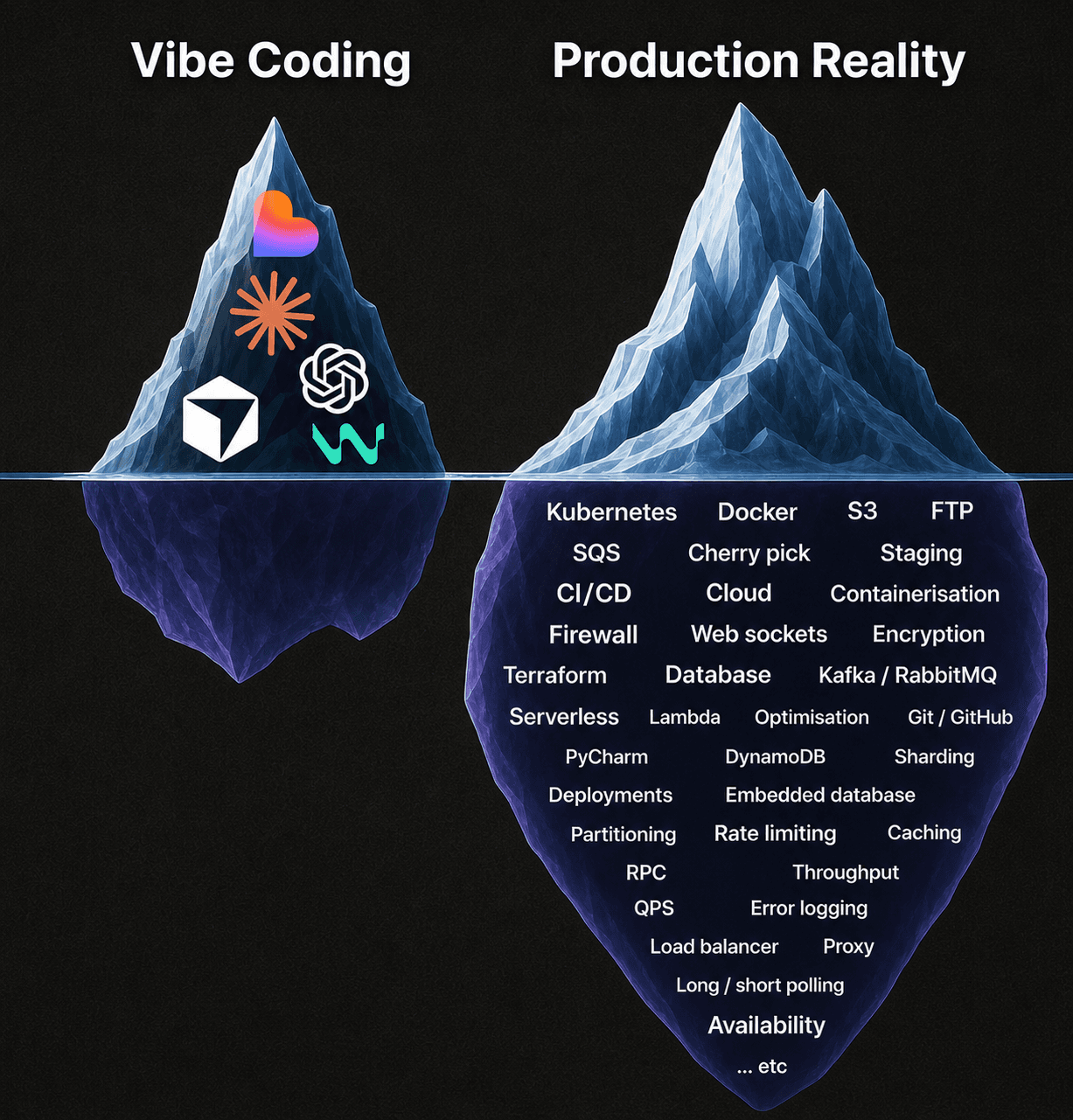
"Vibe coding" means different things depending on who's saying it. On one end, it's sloppy shortcuts with no depth underneath. On the other, it's a genuine shift in how software gets made — knowing what to build, how to direct it, and exactly when to step back in. The iceberg is still there. These tools just change how fast you reach it.
What I've found: with the right curiosity and the right questions, the ceiling is higher than it's ever been. That's not a claim about AI. It's a claim about approach.
Associate Product Manager Intern, learning under Anthony Price.
Since I was young, I knew I wanted to build things and put them out into the world. Software felt like the answer — I just had no idea how it actually worked as a career. Anthony was the first person to explain product management to me. I genuinely didn't know the role existed.
Anthony took me under his wing and showed me the iceberg under product. The tip is cool-looking features. The iceberg is everything else: research, funnels that create stickiness, problems worth solving, decisions that move revenue. He taught me to run user interviews, to think about problems from abstract points of view, to ask what product actually is before assuming I knew. Most of how I work I learned from him.
Cofounded a cross-chain liquidity protocol with Thad Hutcheson.
Crest started in a PhD blockchain course at UT Austin, taught by Professor Vishwanath. That's where I met Thad. We applied to his web3 incubator, ChainHub, and won a $50K non-dilutive grant on the strength of a cross-chain liquidity protocol idea. We built it. We shipped a working proof of concept that ran across five EVM chains, roughly forty times faster than anything else available at the time.
The TBC era and the Crest era were the same era. Grew the Discord from zero to 1,300+, raised $70K+ in sponsorships from Circle, OpenSea, Near, Solana, Tron, and Binance, and ran the Web3/DeFi cohort lectures. Although the real value looking back, was the people. I met some of the smartest and most driven in the UT ecosystem, several of whom went on to YC, Mag 7 exits, and more importantly, became friends for life.
Crest closed for an honest reason: the math. We charged 0.04% of cross-chain volume. To make $40K in revenue, we needed $1B in volume. The only path that worked was launching a token, and we didn't want to play that game in a 2022 bear market. We shipped the product, fulfilled the grant, closed the company, and learned more in nine months than most people learn in three years.
Three years scaling a SaaS digital inspection platform
Lead product demos and on-site enterprise engagements. Close the largest deals at the company.
Own the lifecycle across all accounts. Customer truth feeds directly into product strategy.
Build outbound engines (cold email at scale, ICP segmentation across hundreds of micro-niches). Design paid funnels across Meta, Google, LinkedIn, and SEO.
Work daily with the entire engineering org — often the only non-engineer in the room, learning the surface of every system VLX ships.
Build vertical apps on VLX infrastructure — including one for industrial asset management, sold to an enterprise buyer. Connected back into the core platform — a different front door to the same building.
Lead the org through adoption of Claude Code, Codex, and modern AI dev workflows. Teach designers and PMs — not just engineers — how to ship in sandboxed agent environments.
Claude CodeCodexRewrote internal best practices and shipping rituals around AI-augmented dev.
Took the public site from WordPress to Next.js + Payload CMS.
 Next.js
 Vercel
Started shipping PRs in the actual mobile and web apps.
When I was around seven or eight, I heard Slash for the first time and that was it. I wanted to play Sweet Child O' Mine more than anything. I tried a few times over the years, never stuck with it. At 17 I just decided to commit. Five minutes a day, every day, no excuses. That was the rule.
It worked. And somewhere in that process I realized that this is just how learning anything actually goes. Guitar is a language. So is math, so is code. You find the people who speak it best, you study how they use it, and you repeat the patterns until they stop feeling like patterns and start feeling like yours.
I had the idea for guitarmap.ai for a long time. I kept assuming it was too hard to build, that I didn't have what it took to pull it off. Eventually I just tried. It turned out to be possible, and building it was one of the best things I've done. It genuinely helped my own practice. If you play guitar and you give it a shot, I hope it helps yours too.
Three pieces I'm writing. Drafting now, posting soon.
Operator-side honesty about Claude Code, team adoption, what worked, what didn't.
The fee structure, the bear market, the token decision.
What running demos across seventeen verticals taught me about buyer psychology.
What I read and watch when I'm not building — a window into how I think and what I find worth paying attention to.
My email is an open door. Say hello.
abe@guitarmap.ai